The Ground Under Cincinnati Houses: Kope Shale, Colluvium and Fill
Cincinnati's hills are layers of limestone and soft shale of Late Ordovician age, cut deep by the Ohio River and its tributaries and capped in places by glacial deposits. The shale is the part that matters for foundations: it weathers fast, and the clay it leaves behind slides.
The Kope Formation makes up the lower 60–70 meters of hillslopes along the Ohio River and its tributaries and is about 80% shale in its lower part (USGS, 1994). The Ohio Geological Survey says most bedrock slope failures around Cincinnati happen in it.
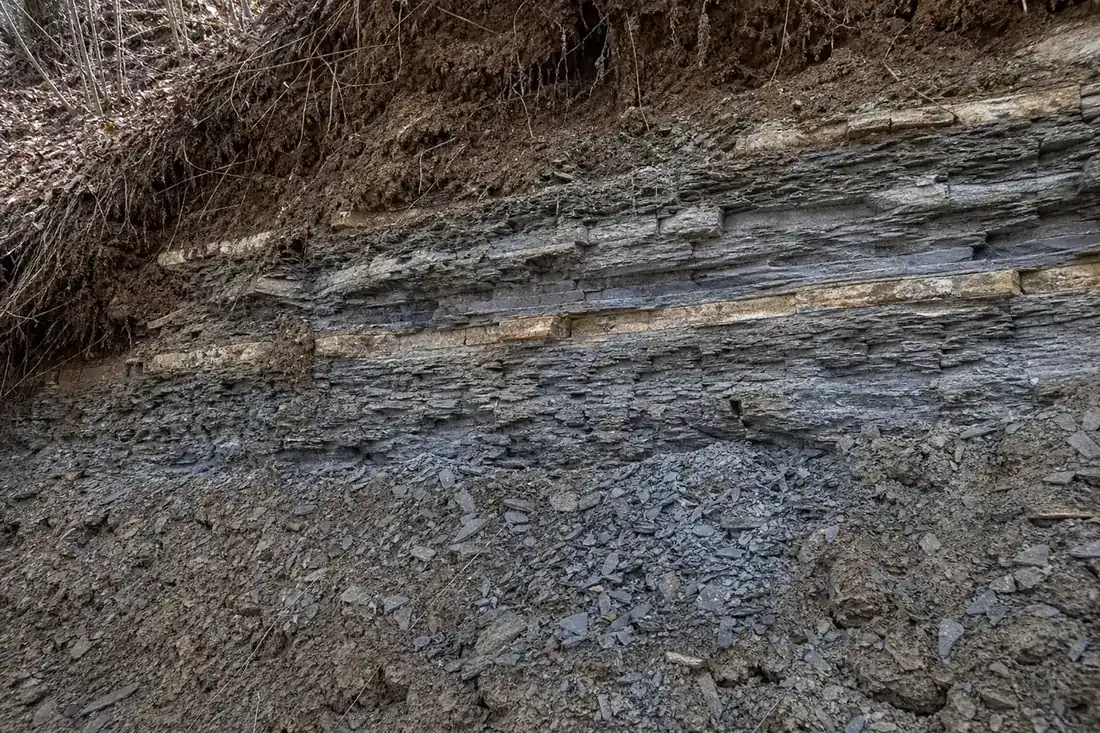
What is the Kope Formation?
It is the oldest of three shale-rich bedrock units around Cincinnati, a stack of shale with thin limestone beds found near river level. The USGS describes the area's shale beds as poorly cemented: they slake, falling apart into their grains, as they wet and dry and warm and cool. Higher on the slopes, the Fairview Formation and the beds above it hold less than 50% shale and stand steeper. Up top, the uplands are mostly covered by glacial deposits; the USGS puts maximum relief in the area at about 150 meters.
Colluvium: the layer that slides
Weathered Kope shale collects on the slopes as colluvium, a stony clay the USGS measured at about 60% clay. It forms a wedge up to about 15 meters thick near the bottom of a slope and a meter or less near the top. Two kinds of slide occur in it. Thin ones, under about 2 meters, tend to move in spring after the thaw, when the ground is briefly soaked to the surface. Thick ones move a few centimeters to a meter at a time, usually in spring but at any season after grading disturbs them. The Ohio Geological Survey names the trigger: water pressure building up in the colluvium. That is why hillside repairs start with drainage.
What the soil survey shows
USDA's soil survey of Hamilton County maps 37% of the county's major soil components as urban land and another 22% as disturbed or filled soil. Among natural soils, Eden silty clay loam is the most extensive, about 16%; its largest mapped area lies on 25% to 40% slopes. Eden soils form in weathered shale, siltstone and limestone and have a firm, sticky clay subsoil that lets water through slowly. Fill and clay together explain many cracked basement walls.
What landslides have cost Hamilton County
The USGS reported that per-capita landslide damage in Hamilton County was among the highest in the country: about $5.80 a person each year from 1973 to 1978, nearly $31 million over those six years, before inflation. That total left out nearly $30 million spent after 1978 on a single 1974 slide in Mt. Adams. The city now says about 19% of its area is hillside steeper than 20%, and it is reviewing its hillside building and zoning rules with The Hillside Trust. FEMA's October 2026 disaster declaration for the August storms, which covers Hamilton County, names landslides in its title.
Sources
- U.S. Geological Survey Bulletin 2059-B: Landslides in Colluvium (PDF)
- Ohio Department of Natural Resources, Geological Survey: GeoFacts No. 8, Landslides in Ohio (PDF)
- USDA NRCS Web Soil Survey (Hamilton County, Ohio)
- FEMA DR-4945-OH: Ohio Severe Storms, Straight-line Winds, Tornadoes, Flooding, and Landslides
- City of Cincinnati: Hillside Initiative
What is the house, or the hill, doing?
A crack that keeps growing, a door that started sticking, a yard or retaining wall that is leaning, water after a storm: a sentence or two is plenty. It goes to one independent foundation specialist who works in Cincinnati.