Hillside Foundation Repair: When the Slope Under a Cincinnati House Moves
Hillside foundation repair in Cincinnati is a different job from fixing a cracked wall. When the ground below a house is creeping downhill, patching the cracks only resets the clock. The work starts with finding out how deep the moving soil goes and why it is wet, and only then turns to the house.
Cincinnati requires a geotechnical engineer's soils report and field supervision for earthwork on active slides, slopes steeper than 3 to 1 and lots in the Hillside overlay (city handout, 2017). Fixr (2026) prices that report at $1,000–$5,000 and piers at $1,000–$3,000 each.
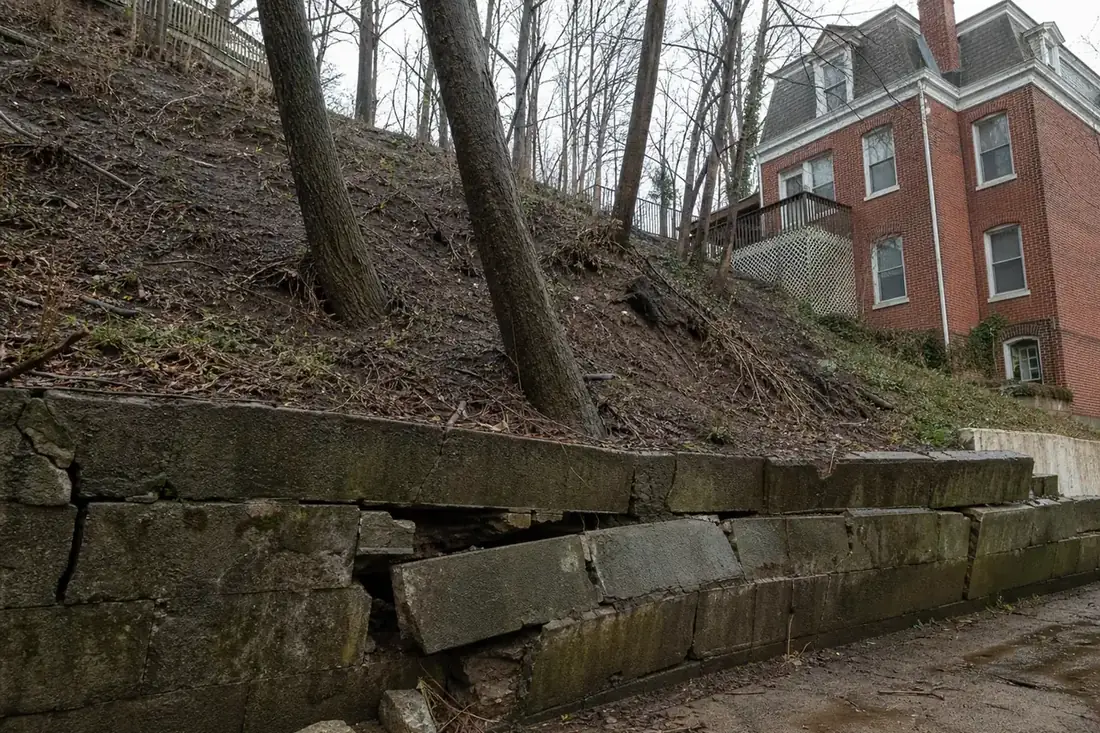
Signs the hillside, not just the house, is moving
- Cracks that widen on the downhill side of the house, or a porch or garage pulling away from it.
- A retaining wall that leans out, bulges or has opened at its joints.
- New steps, cracks or bulges in the lawn; the Ohio Geological Survey calls these scarps and hummocky ground.
- Trees or fence posts tilted at odd angles, and water seeping out of the slope after rain.
- Sidewalks, driveways or utility lines that shift or break more than once.
One sign alone may be minor. Several together, especially after a wet spring, are a reason to get the lot looked at soon.
Why Cincinnati slopes give way
The U.S. Geological Survey's study of landslides around Cincinnati found that the most common and destructive slides are in colluvium, a wedge of stony clay weathered from the shale beneath. The Kope Formation, about 80% shale in its lower part, forms the lower 60 to 70 meters of hillslopes along the Ohio River and its tributaries. Colluvium can be about 15 meters thick near the bottom of a slope. When water builds up inside it, it slides; the Ohio Geological Survey adds that cutting into the toe of a slope, piling fill near the top, removing trees and letting downspouts empty onto the slope all make failure more likely.
How hillside foundation repair is usually done
- Investigate: borings and a soils report to find the depth of the moving layer and the water in it.
- Drain: take roof and surface water off the slope and, where needed, drain the slope itself. Water is the usual trigger.
- Underpin: steel or helical piers driven through the colluvium to firm material, so the house no longer rides on the moving layer. Fixr (2026): $1,000–$3,000 a pier.
- Retain: a designed wall, often on piles or with tiebacks, where the slope below must be held. Fixr (2025): $3,500–$10,000 for a typical new wall, more on a slope.
A small timber wall stacked at the toe of a big slide rarely holds it. Ranges for each step are on the Cincinnati foundation repair cost page.
City rules on landslide areas
The City of Cincinnati maps landslide susceptibility and keeps a list of active slides. Its handout requires a geotechnical engineer for earthwork on those sites, on slopes steeper than 3 horizontal to 1 vertical, for excavations deeper than 12 feet or next to a building that could be undermined, for more than 5 feet of structural fill, and in the Hillside overlay. Retaining walls, excavation and filling land need their own permits. The handout dates from 2017 and the city is reviewing its hillside rules, so have your engineer confirm what applies today; the rules page has more.
Questions homeowners ask
Is a slow-moving slope an emergency?
Usually not today, but it rarely stops on its own. The USGS measured small movements nearly every year at one Cincinnati-area slide over 37 years, with sudden jumps in wet years. Move downspout water away from the slope now, mark crack ends with the date, and get a soils report before spending money on the house itself.
What is the house, or the hill, doing?
A crack that keeps growing, a door that started sticking, a yard or retaining wall that is leaning, water after a storm: a sentence or two is plenty. It goes to one independent foundation specialist who works in Cincinnati.