Cracked and Bowing Basement Walls in Cincinnati: Block, Brick and Stone
Cracked and bowing basement walls in Cincinnati come in two broad kinds. Block walls from the middle of the last century bend inward under wet clay. Older stone and brick foundations, laid with soft lime mortar, tend to lose mortar, bulge and let water through rather than snap. The repair depends on which you have.
Fixr (2026) prices bowing wall repair at $4,000–$15,000, wall anchors at $1,500–$2,000 each, and carbon fiber strips at $4,000–$12,000 for a typical job. Injecting a single crack runs $200–$1,000. Ohio's residential code sets exterior footings at least 12 inches below undisturbed ground.
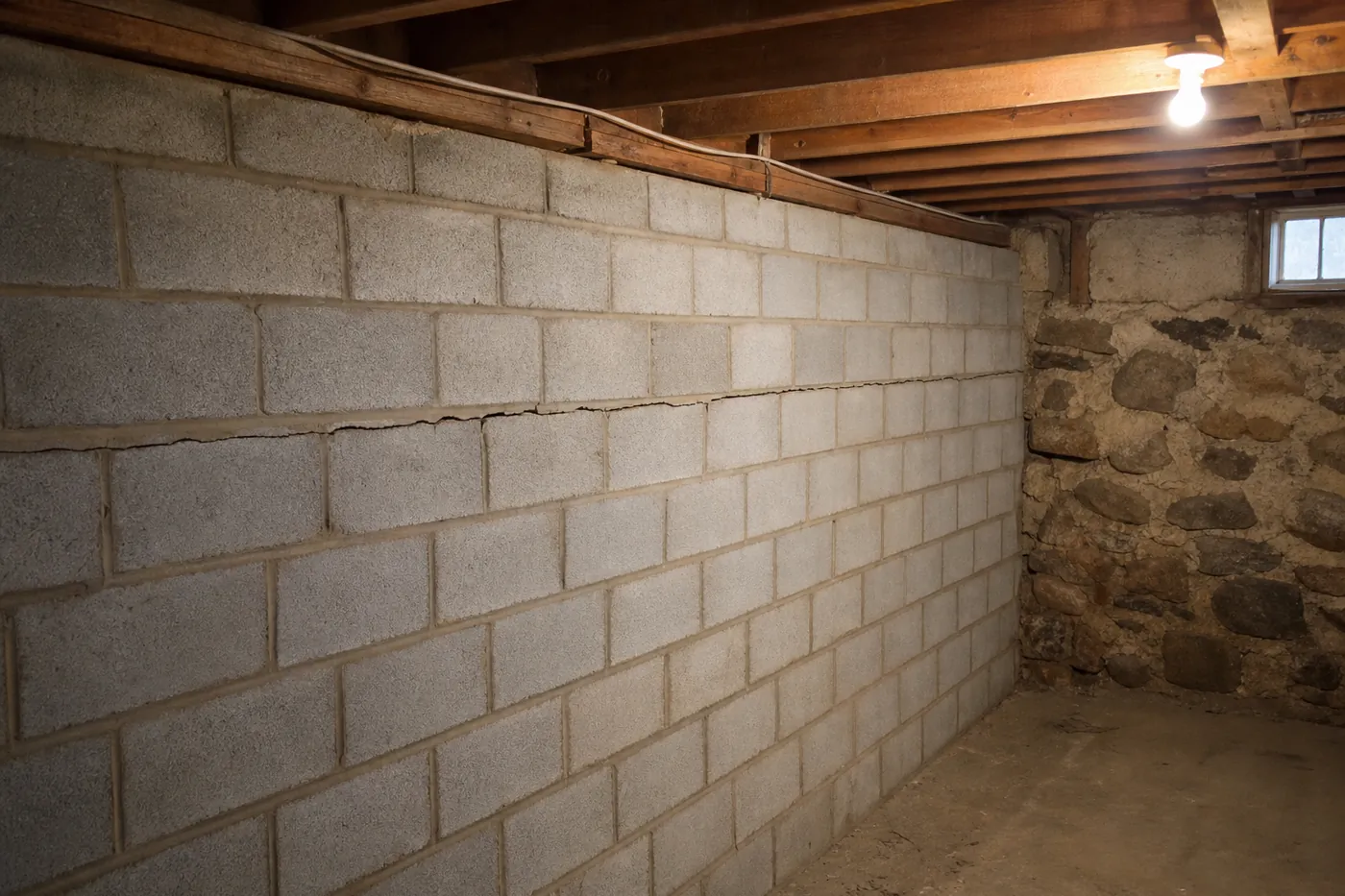
Which cracks in a Cincinnati basement wall matter?
- Horizontal crack in a block wall, a few courses down: soil pressure. The wall is bending inward. Measure it.
- Stair-step cracks along mortar joints near a corner: the corner may be settling, or on a slope, moving with the ground.
- Thin vertical crack in a poured wall: often shrinkage. It matters if it leaks or one side sits proud of the other.
- Crumbling mortar and bulges in stone or brick: age and water. Repointing and drainage may do more than bracing.
Why basement walls here take a push
Much of the ground around Cincinnati is clay-rich. The soil survey's most extensive natural soil in Hamilton County, Eden silty clay loam, has a firm, sticky, plastic clay subsoil and slow permeability (USDA NRCS), and the USGS measured about 60% clay in the colluvium on local slopes. Clay holds water against a wall and swells and freezes in winter; NOAA's normals give about 102 nights a year at or below freezing at Lunken Airport. More than half of the county's mapped soil is urban land or disturbed fill, which drains unpredictably. And with a median year built of 1951 (U.S. Census), many walls have taken that push for 70 years or more.
Repair options for cracked and bowing walls
- Crack injection: epoxy or polyurethane in a poured wall. Fixr (2026): $200–$1,000.
- Wall anchors: plates inside tied to anchors buried in the yard, tightened over time. Fixr (2026): $1,500–$2,000 each. They need room outside, which steep or narrow lots may not have.
- Carbon fiber strips: bonded inside; hold a wall that has moved little. Fixr (2026): $4,000–$12,000.
- Steel beams: braced from floor to joists where nothing can go outside.
- Excavate and rebuild: for walls that have moved too far, with new drainage before backfill.
- Repointing stone or brick: new mortar matched to the old, so the wall can still breathe.
Before you sign
Measure the bow with a string line and date the crack ends, then check again after spring. If the house sits on a slope, rule out ground movement first; bracing a wall on a sliding lot treats a symptom. Ask whether the work needs a city permit, which the residential permit guide requires for structural changes, and check the contractor's City of Cincinnati registration. Compare methods on the Cincinnati foundation repair cost page.
Questions homeowners ask
Can an old stone foundation be fixed, or does it need replacing?
Most can be repaired. Stone foundations usually fail slowly, as mortar washes out and water finds its way through. Repointing with a soft mortar, parging, and fixing gutters and grading often stabilize them. Rebuilding is for sections that have bulged badly or lost stones. Ask for a mortar suited to old masonry; hard cement mortar can damage soft stone.
What is the house, or the hill, doing?
A crack that keeps growing, a door that started sticking, a yard or retaining wall that is leaning, water after a storm: a sentence or two is plenty. It goes to one independent foundation specialist who works in Cincinnati.