Two named guides, each with its date
Cincinnati Foundation Repair Cost: Walls, Piers, Slopes and Water
Foundation repair cost in Cincinnati depends on where the house sits as much as on what broke. The same cracked wall costs one thing on a flat street and another on a steep lot above the Ohio River, where a soil report and deeper supports come first. No public agency publishes what Cincinnati contractors charge, so the ranges below come from national guides, each named with its date.
Fixr's 2026 guide puts most foundation repairs at $2,200–$8,200 (average $5,200), and This Old House (2026) at $2,224–$8,134. Piers run $1,000–$3,000 each, a geotechnical soil report $1,000–$5,000, and full house leveling $20,000–$30,000 (Fixr, 2026).
Foundation and basement prices to hold a Cincinnati bid against
| Work | Guide and year | Range in the guide | What moves it on a Cincinnati house |
|---|---|---|---|
| Foundation repair, typical job | Fixr, 2026 | $2,200–$8,200; average $5,200 | Which repair it turns out to be |
| Foundation repair, second guide | This Old House, 2026 | $2,224–$8,134; average $5,179 | Same: the method sets the price |
| Sealing or injecting a crack | Fixr, 2026 | $200–$1,000 | Poured wall or old stone and block |
| Bowing wall repair | Fixr, 2026 | $4,000–$15,000 | How far the wall has moved |
| Wall anchors | Fixr, 2026 | $1,500–$2,000 each; $5,000–$15,000 a typical job | Room outside on a narrow or steep lot |
| Carbon fiber strips | Fixr, 2026 | $4,000–$12,000 | Wall length and finished basements |
| Piers under a footing | Fixr, 2026 | $1,000–$3,000 per pier | Depth through colluvium to firm rock |
| Underpinning | Fixr, 2026 | $10,000–$40,000 | Whole walls rather than one corner |
| House leveling | Fixr, 2026 | $20,000–$30,000 | Lifting an old frame without cracking plaster |
| Sagging floor repair | Fixr, 2026 | $1,000–$8,500; $150–$325 to sister a joist | Number of joists and the main beam |
| New retaining wall | Fixr, 2025 | $3,500–$10,000; average $5,463 | Height, drainage and engineering |
| Basement waterproofing | Fixr, 2026 | $3,000–$10,000; interior drain $40–$120 a foot | Basement perimeter and access |
| Sump pump, installed | Fixr, 2025 | $800–$2,000; $350–$1,000 to replace | Cutting a new pit in an old floor |
| Slab jacking a stoop or walk | Fixr, 2026 | $500–$1,900 | Whether the ground under it is still moving |
| Structural engineer report | Fixr, 2026 | $300–$2,000 | A letter or a full repair design |
| Geotechnical soil report | Fixr, 2026 | $1,000–$5,000 | Borings on a steep or sliding lot |
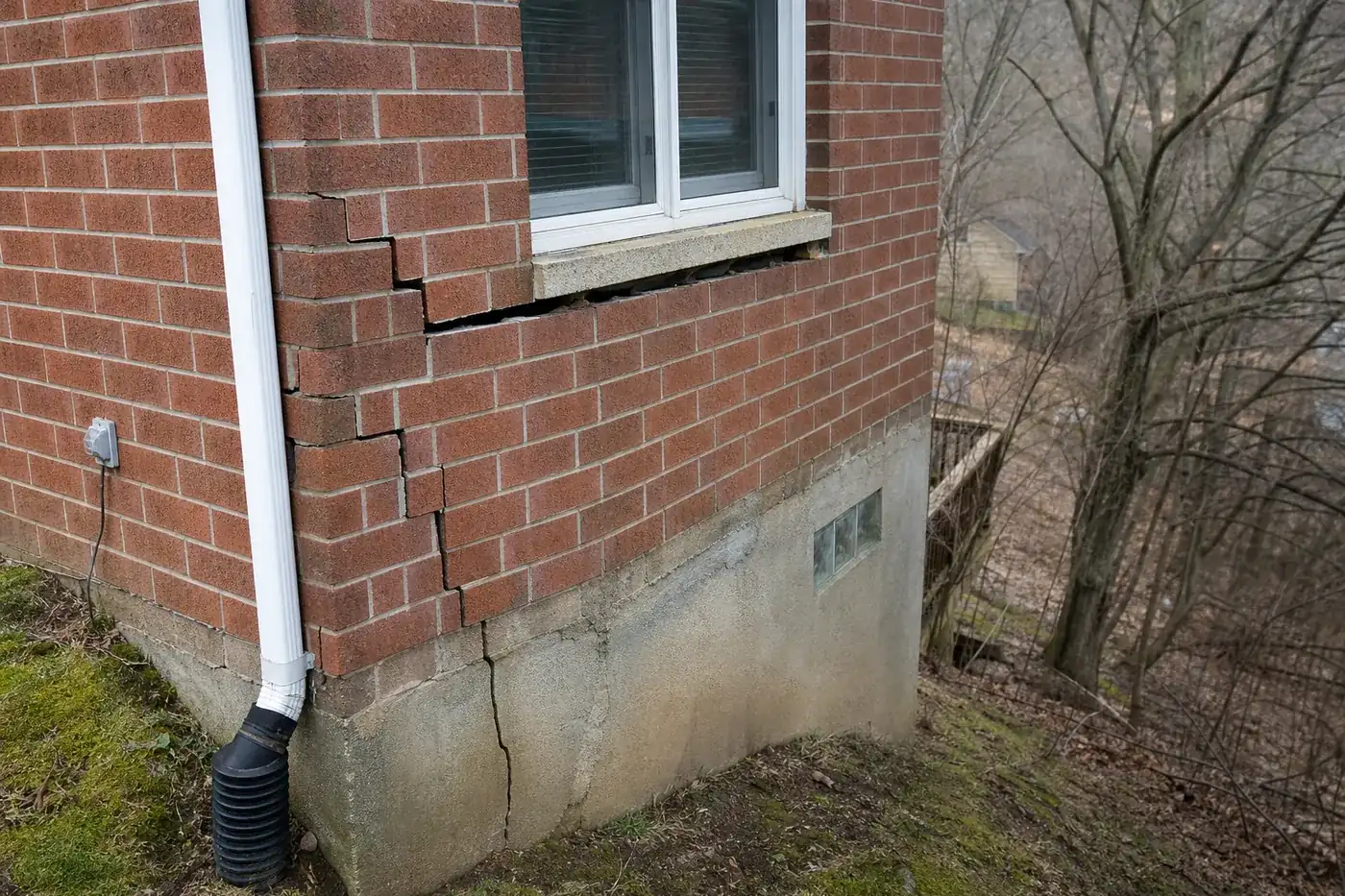
What raises foundation repair cost on a Cincinnati hillside?
- Engineering first. The city's landslide-area handout (revised 2017) requires a geotechnical engineer to report, recommend and supervise earthwork on sites with an active slide, slopes steeper than 3 to 1, deep excavations next to a building, and lots in the Hillside overlay. Fixr (2026) prices a soil report at $1,000–$5,000.
- Deeper supports. Colluvium can be about 15 meters thick near the bottom of a slope (USGS), so piers may run much deeper than on flat ground.
- Walls that hold the yard. Fixr (2025) puts a new retaining wall at $3,500–$10,000 and building on a slope at $40–$200 a linear foot, and says walls over 4 feet need a structural engineer.
- Access. Steps, steep side yards and attached neighbors slow equipment and hand-carrying.
- Old masonry. Stone and brick foundations need matching mortar, not just epoxy.
Permit, registration and engineer lines on a bid
Nationally, Fixr lists permits at $75–$150; Cincinnati charges its own fees, so the permit should be its own line. The city's residential permit guide requires permits for major repairs and structural changes and separate permits for retaining walls, excavation and filling land. Every contractor working inside city limits must hold a current City of Cincinnati registration, renewed each year, and the city's advice to homeowners is to ask for the registration number and its expiration date.
Ways to keep the bill down
- Move roof water off the slope. The Ohio Geological Survey warns against letting downspout water discharge onto a slope. Fixr (2026) lists gutters and downspouts at $3–$30 a foot.
- Commission the report yourself on a moving lot, so the design is not tied to one company's product.
- Get three bids, as the city recommends, priced by pier or anchor count and spacing.
- Pay in stages. The city advises never paying the bulk up front and getting a dated receipt for every payment.
Methods are explained on the hillside foundation repair page.
Cost questions
Why does a hillside foundation repair cost so much more?
Because the house is only part of the job. On a moving slope the specialist may need a geotechnical report, piers driven through thick colluvium to firm rock, drainage to lower the water in the slope, and sometimes a retaining structure. Each is a separate line. A flat-lot repair skips most of them, which is why national averages can look low for a steep Cincinnati lot.
Will MSD pay for water in my basement?
Only for one kind of water. MSD's Sewer Backup Program helps with wastewater that backs up from the public sewer because of capacity or certain maintenance problems, and it must be reported within 48 hours of discovery. Groundwater seeping through a wall is not a sewer backup, and MSD lists overland flooding as not eligible. MSD investigates each report and decides eligibility.
Should I hire an engineer before a contractor?
On a sliding or steep lot, usually yes, and the city may require one. For a single cracked wall on flat ground, many homeowners start with a specialist and bring in an engineer if the wall has moved a lot. Fixr (2026) prices a structural engineer's report at $300–$2,000 and a soil report at $1,000–$5,000.
What is the house, or the hill, doing?
A crack that keeps growing, a door that started sticking, a yard or retaining wall that is leaning, water after a storm: a sentence or two is plenty. It goes to one independent foundation specialist who works in Cincinnati.